

Discover my feedback on my training at Greta. A complete, honest, unfiltered account.
Table of contents
Real-world use case
You want concrete examples of projects carried out in a BTS SIO program: here's an overview of my studies at Greta-Viva5 in Valence.
The end of my account of my training at Greta-Viva5
Some will be relieved to learn that my revelations are coming to an end, while others will be left wanting more. In 2014, two long posts were published about my feedback on my training at Greta-Viva5 in Valence to explain the events that took place there.
Do we need a digital PISA study to understand our lag?
Today, the government has bought gadgets for younger generations to give them a semblance of digital and computing proficiency. Young people won't become any more skilled with this kind of method, quite the opposite. The word "computing" has become degraded, as has the perception of IT tools. Nowadays, you just need to look at the BTS SIO program offered, for example, at Greta-Viva5, to see it for yourself. To illustrate my point, here's a clip from a YouTuber:
This long-running slumber is the result of an outdated school system. Discovery, knowledge, imagination, and learning are very important to me, but the willingness of curious, self-taught people to produce work on their own isn't acceptable within a school setting. It's clear I was judged negatively for my professional work on the E4 and E6 exams at Greta in Valence, but the best thing is still for you to judge for yourselves the quality (or lack thereof) of my various pieces of work, which I'm now presenting to you with no filter.
The exam constraints:
During my final meeting for this BTS, I wanted to highlight the skills I developed over my years as a self-taught learner, as well as at my company. I didn't settle for blindly copying the six hands-on labs covered in class. I built my E4 and E6 projects while staying true to myself, following the exam rules while also facing the challenges that came up:
- Complying with the mandatory elements of the rules provided for the E4 exam: attached (PDF).
- Complying with the teachers' choice, who didn't want to see Linux and FreeBSD used, but Linux and Windows.
- Following the specifications provided for the E6 exam.
- The constraint of the network and the Ipcop 1.4 distribution, which was mandatory at first, but which I removed as soon as I could.
- Greta's administration doesn't know how the BTS exams unfold at the end of the year.
- The exam board remained unclear until the last day (as an anecdote: an email sent to my employer).
- Greta's vCenter infrastructure can't handle the burst load given the number of students using 4 or even 5 Windows machines at once.
- A shortened, changed deadline for submitting documentation on the unsecured, unstable NAS system.

Some of my choices were forced on me, and I had to keep readjusting my project throughout, all while knowing the exam board would be made up of my own teachers (continuous assessment). So they had decision-making power over whether I'd get my BTS. I knew I had to produce work that stood out more than the other students', in order to prove my real technical and professional worth given these two difficult years.
My preparation for the E4 exam
The IT solution I had to propose was based on a VMware ESXi cluster managed by vCenter, since that was a shared prerequisite. But a week before the deadline, my final infrastructure wasn't finished. I tried out different options to be sure of my choice. Time caught up with me when the teacher came up to me and asked where I stood. I told him I had nothing concrete, so I quickly sketched out the draft below while explaining my idea to him:
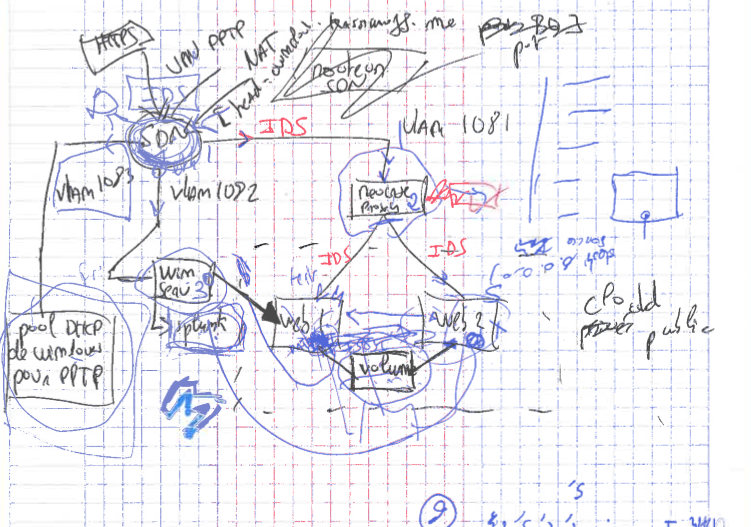
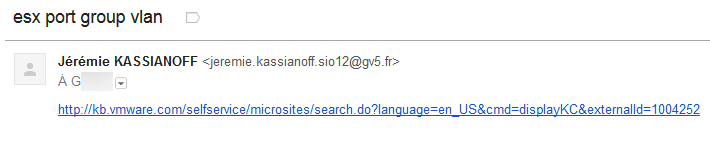
I remember him telling me there was a lot of work and that it was going to be difficult, especially since I still hadn't done my E6 documentation. I started my project in a rush and asked the teacher to create a port group in 4096 for me, then three other tagged ones: 1081, 1082, 1083. The teacher didn't know how to do this and didn't understand it. The trunk on my port group in my vSwitch let me save on Ethernet controllers on VyOS. Once he understood that, I ended up giving him the solution by providing a VMware KB link (with proof):
The overall diagram of my E4 project:
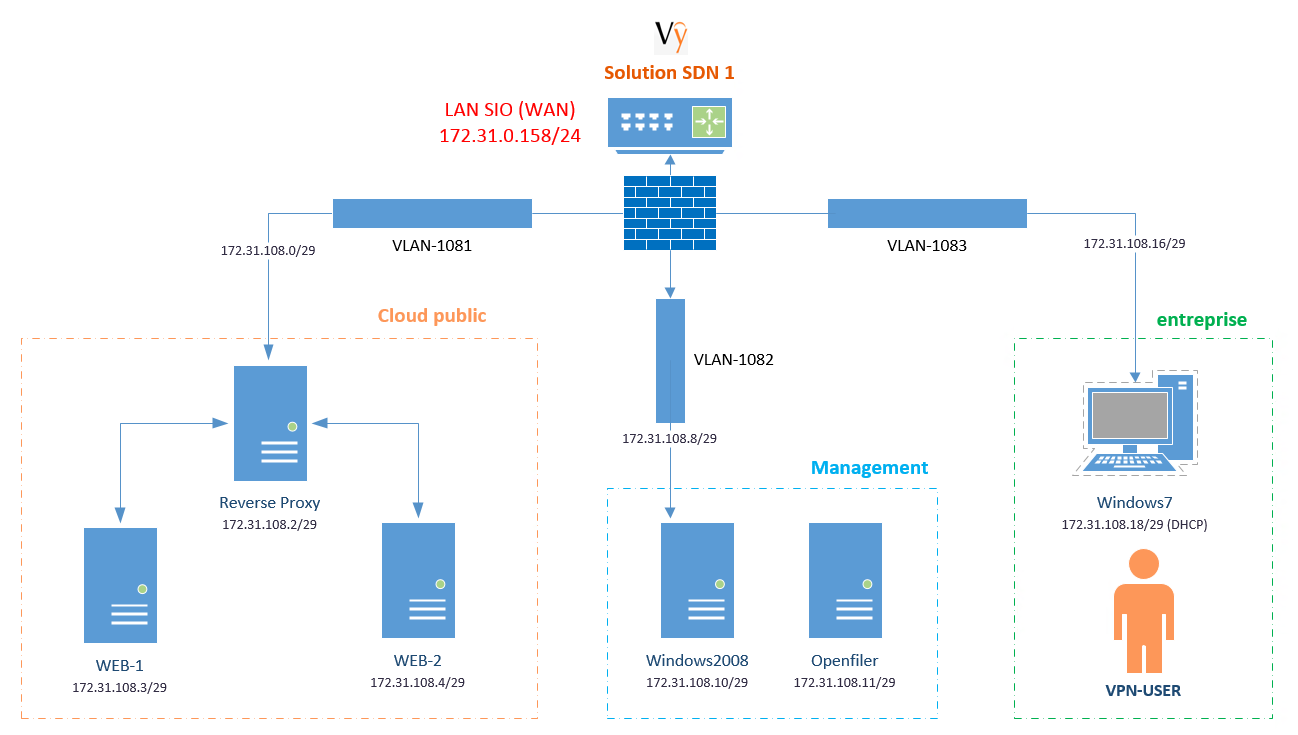
The infrastructure, viewed from the inside, consists of a WAN interface and a LAN card used by logical sub-interfaces. Each VLAN corresponds to a zone and a specific use, with the various services that make it up:
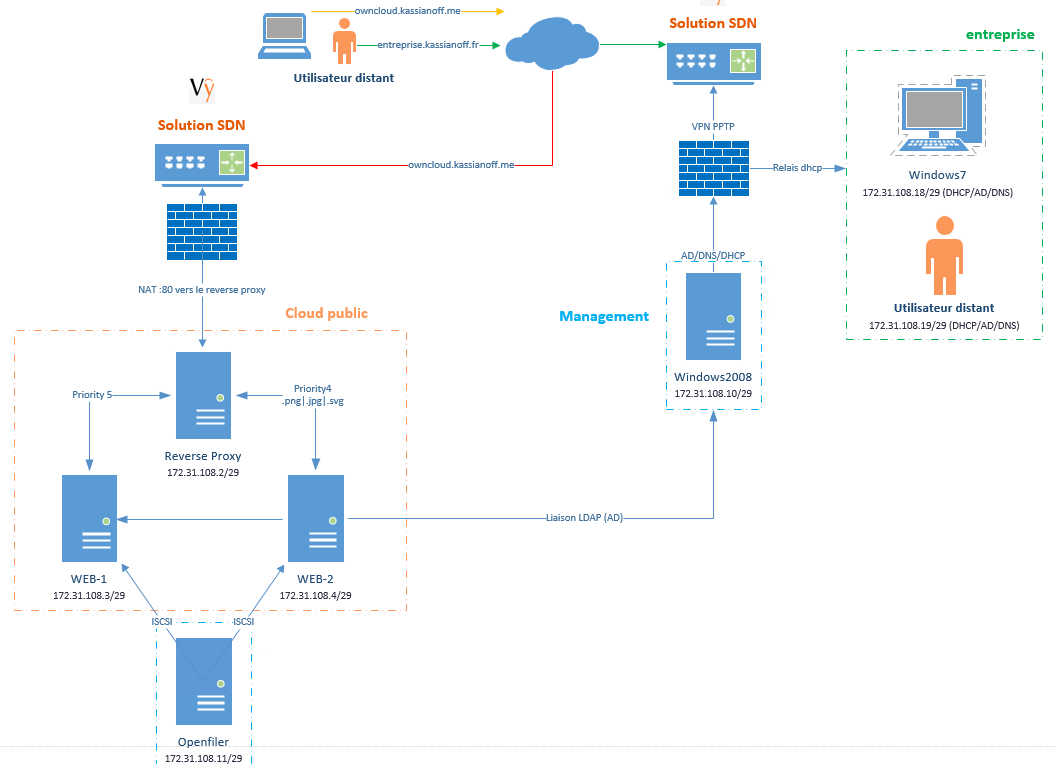
Service number 1: owncloud.kassianoff.me (error in the zone: private cloud, not "public cloud").
The remote user connects to the cloud interface, and the reverse proxy offers them the WEB-1 server (but both web servers are, respectively, two ownCloud instances). The first loads static and dynamic pages, while the second, WEB-2, handles offloading images in .png, .jpg, .svg formats. The service enables load balancing to handle a failure of one of the two web servers. To round it all out, the user is then authenticated by Windows AD on ownCloud, and the data is backed up and synchronized in real time on a remote iSCSI volume named "Openfiler" in the diagram.
Service number 2: entreprise.kassianoff.me (error in the diagram: .fr extension, not ".me")
The remote user connects via the Microsoft PPTP VPN client to the VPN server, which redirects them directly into their corporate network to access its resources. They get DHCP and the DNS server from Windows 2008, and nothing stops them from also communicating with ownCloud locally. To round out my solution for cloud access, I used a VRRP service, which keeps a gateway always available on the 172.31.108.0/29 network, like this:
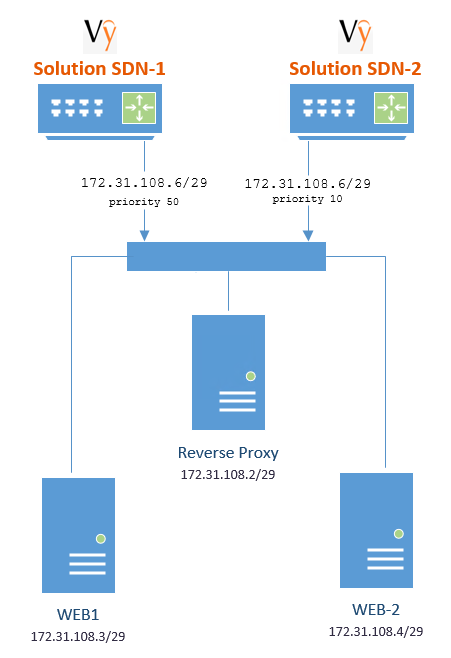
At that exact moment, I had an idea of the work I needed to do on Greta-Viva5's server farm in Valence.
Knowing I only had 7 days left, it took me 3 to finish building my E4 infrastructure.
My preparation for the E6 exam
In the race against time to finish my files, the E6 exam is the longest, since this exam, called "Professional development pathway", requires rigor in writing and presentation (at least, that's what I believed). In practice, I could see the exam board doesn't actually read them. Trying to do things right, I had a hard time deciding which documentation to present, but here again it was time that dictated my choices:
- Selecting a hypervisor and performing a P2V conversion test
- Designing an outsourced infrastructure hosted at online.net
- Cabling, installing, and configuring a computer network
- Developing an SDN solution with VyOS
- Private cloud architecture on Linux with Windows AD integration
- SpiceWorks IT Desktop network inventory and helpdesk
- iSCSI Target backup solution with OpenFiler
- Zimbra 8, open-source collaborative messaging
- Remote support and Helpdesk with Panda Cloud Systems Management
- Means of expression and technology watch
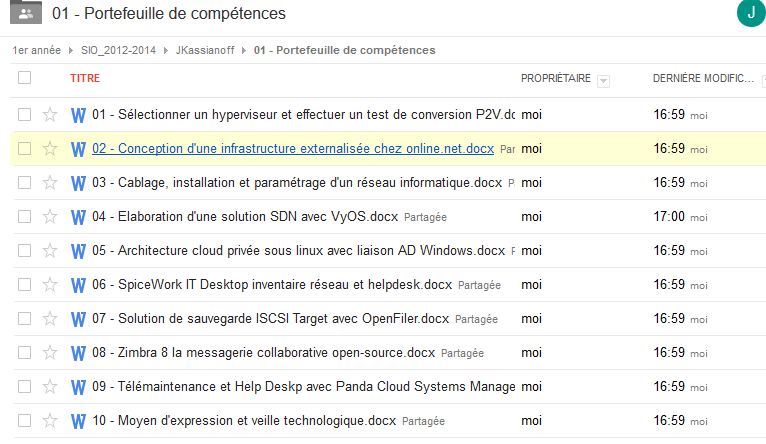
My skills portfolio was made up of 10 documents covering different topics:
- The hypervisor: a virtualization platform (1 to 3).
- Software-based network virtualization (2 to 4).
- Server solutions: free and proprietary (5 to 8).
- The last two topics were dictated by the curriculum framework and represent one document each (9 and 10).
Validating my files
Given how far behind I was, with 2 documents missing and no E4 infrastructure in place, the hardest week of my BTS was the one before Monday, May 26, 2014. I remember that over that weekend, from Friday, May 23 to Sunday, May 25, 2014, I spent 23 hours straight writing over and over, then another 17 hours the next day. Knowing Monday, May 26, 2014 at 5:00 PM was the deadline to submit my projects, I kept going throughout the day and for a few hours before it closed. I checked my server farm and, as a precaution, backed up my VMs (clone).
Two validation steps:
- Describe and fill in my summary table on this Greta-Viva5 Synology NAS.
- Upload my various documents to Google Cloud (my OwnCloud was rejected).

I was inches away from not being eligible, given how far behind I was (the deadline was set at 5:00 PM max):
A closer look at my E4 and E6 documentation
My documentation seems to hold up, aside from what's available online, since it didn't let me pass the BTS. Comparing myself to other students who seem to have gotten their diploma without much trouble, with examples here and there, it seems fair for me to also show my work, which I'd like to share with as many people as possible. My documentation follows a style and a graphic charter I set for myself.
I'm sharing all my documentation on the following page: documentation for my BTS SIO projects.
My oral presentation support material is available at the following address. Or discover it below by doing the following: (right, down, then always right)
https://static.exagon.me/fichiers/11/slides-bts\_portefolio--2.html#/
The source files are available here: https://www.kassianoff.fr/bts-sio/
Thanks to my sister Mathilde
Given how worryingly behind I was, I had to take days off work and asked my 17-year-old sister to spend a few hours a day with me. She helped me enormously in finishing my documentation on time. We'd sometimes laugh nervously and raise our voices over not much, really. But looking back, it's a good memory, despite the outcome I later got. Within 3 days, I created all my documentation, totaling 117 pages, but that wouldn't have been possible without my sister's tremendous support, for which I'm forever grateful.
How my E4 exam went
The way the E4 and E6 exams unfold can vary from one year to the next, but describing what I went through already gives an idea. So I did my best to remember my orals and the work my teachers, who were, at that point, my exam board, asked of me. At the start of the E4 exam, a board member gave me a sheet with a task to complete. Solving the problems happens in several phases:
- Doing personal research for half an hour on the web to solve the problems.
- Explaining the resolution methods to the board, who are also there to redirect the candidate in case of trouble.
- Carrying out the requested task by doing the work. The board then comes to check that it works.
The board's various requests
The additional elements I was asked to add were as follows:
- An address range between: 192.168.16.0/24 and 192.168.31.0/25, which needed to contain 3 subnets of 255 hosts, 128 hosts, and finally 32 hosts respectively (VLSM).
- An OSPF routing protocol to be set up on the VyOS router in order to make its networks communicate.
- Setting up a rule that blocks internet access for all of vlan1082 except for the Windows Server.
- Simulating exporting the configuration to an FTP server (no need to actually set up an FTP server).
- Recording and taking notes of my actions in a digital format.
My methods for solving the given problems
- I proposed the following subnets: 192.168.17.0/24, 192.168.18.0/24, 192.168.19.0/26. You've probably noticed the rather glaring mistake. The teacher put me on the right track, and I understood: 255 hosts, not 254. So I replied that I'd have to redo my VLSM addressing afterward. I redid my addressing in 5 minutes with: 192.168.17.0/23, 192.168.18.0/24, 192.168.19.0/26.
- For OSPF routing, I'd do it with the help of commands from blogs and/or official resources (wiki), using a loopback interface to declare my AREAs. The teacher told me a network was missing, and that the loopback wasn't an end in itself. I replied I'd create another network if it was required, but that I hadn't understood that, since I thought the loopback interfaces would let me do it directly. Then they asked me for the commands to check that OSPF was working properly, I answered a show route IP and show route IP OSPF, followed by a ping to another machine on the neighboring network. I had to repeat several times that the command showed the propagated OSPF routes, since it was a bit unclear to the board. The mood was souring, the teacher was explaining to the other teacher that VyOS used Quagga for routing…
- For the web filtering rule on vlan1082, I simply said I'd stop my source NAT on the VLAN's network except for the Windows server's address. No further reaction from the board.
- Regarding exporting my configuration, I'll use the TFTP command, not FTP as requested, following the official wiki's recommendation. I read the command out loud to make sure we were talking about the same thing. He just gave his approval, explaining he would have preferred FTP.
- The last thing was that I had to record and note down, in an electronic document, all my solutions and how they were built (screenshot, command, explaining the approach), a waste of time in itself.
Conclusion on my E4 exam
My OSPF setup with the three VLSM networks, as well as the OSPF verification with the commands mentioned above, worked perfectly. The ping worked, everything was OK. The filtering rule wasn't put in place because I focused on writing the documentation. Since it only took a few seconds to add, I wanted to do it in front of them, but they refused to let me show them the command live (it had to be in place before they arrived). Then, for TFTP, I showed the command (simulated, without commit). Everything worked well, but I believe they considered my sources coming from blogs as unacceptable despite the excellent results and my explanations. They noticed I had created one extra Area on the loopback interfaces in OSPF. And they didn't take my beginner's mistake on the VLSM addressing well.
Final result on the E4 exam: 10/20
How my E6 exam went
My E6 exam was a chance to share, explain, and highlight the projects I'd built. Yet during the oral, nothing went as planned. The board was unresponsive, clearly bored being in the room with me, and considered my slides not relevant "in either form or substance," to quote them. As for me, I followed this approach:
- The outward presentation matters, appropriate attire, a shirt is expected.
- The presentation of the documentation and slides needs to be polished.
- The relevance of the critical analysis of the professional development pathway needs to be established.
- Explaining a few configuration cases, along with their choices and benefits, to demonstrate their effectiveness.
My E6 oral
At the entrance to the room, the industry member of the board came to shake my hand, introducing himself quickly. I'll admit that, not having yet entered the room, I was caught off guard and didn't catch his first and last name. Let's call him Mr. PIM. The other board member was my networking teacher, who had already been present at the E4 exam. I got set up and started my speech, supported by my slides. As for how my exam unfolded, I won't dwell on every slide, but will instead focus on the board's behavior and reactions to my presentation, my work, and my project choices. Clearly, these three points didn't convince them. On top of that, I printed my documentation so the board could follow along and refer to what I was saying during my oral while I guided them, to make the exchange more relevant.
The board's criticism during my E6 exam
The teacher told me he didn't understand my role at the company or what my company does. So I repeated what I'd said at the beginning, namely that we manage several SMEs in addition to one large client. My role is to be fairly autonomous and versatile. We provide IT services to SMEs and at our big client's site (fleet management).
The teacher then asked me how many people work at the company. I repeated that my versatility led me to work with different types of clients, but that I didn't know the number of individuals managed by us, since my employer doesn't share that kind of information with me. I don't have tools to know my clients. I remember giving a random number, 1000, not knowing what else to say. I then explained that there were only two of us at the company.
– "So you've done a variety of tasks," the teacher said, to which I replied yes and explained that, in another context, I'd also taken part in various events and training sessions I helped run or attended during my work-study program at the company.
There were about 15 minutes left when the industry board member (Mr. PIM) spoke up and told me he hadn't understood much, criticizing me for dwelling on command lines, and that he hadn't understood the tutorial on VyOS, which he thought was a router. I told him it was indeed a virtual router and that I could provide more details if he wanted, but he said no.
He continued by asking me where the interaction with SDN was in VyOS, criticized me for spending 25 minutes on 4 slides I commented on when, according to him, a simple diagram would have sufficed, and that, ultimately, he hadn't really understood what I'd done. He stated that my documentation had problems in both substance and form, because "you just shouldn't do that at all."
He continued on vSphere, criticizing me for making "a mountain" out of vSwitches and port groups, saying it takes two seconds, same for VRRP, which is "two lines, no more." He asked me whether I'd put my documentation into production, I confirmed that's exactly what I'd done, but he continued, asking why I'd put the SDN into production in document 4, and whether there was a Beta version.
I retorted that he was probably talking about OVH's vSphere BETA in their manager, VyOS doesn't have a BETA version. Yes, because at OVH, it's in BETA version in their own internal management.
He then told me that, as a CIO, he found it hard to believe I'd put a BETA version into production. I replied that the decision was made by my boss, and that I only implemented it. He then told me my boss "is heading straight for a wall."
I then asked him if he knew the difference between version 5.1 and 5.5, he said no, so I explained that a key feature is support for 64GB of memory in the free version, perfect for our EG64s.
He retorted that he himself doesn't make the mistake of using Beta versions. I replied that we're bound to follow the guidelines set by our employer. He told me that the whole point of having a boss is that he knows a bit more, and that of course you can have an ego problem with that. I asked him why, that we have a communication issue, and that the number of users discussed earlier is proof of that. End of his remarks.
The teacher also asked me what VyOS is, I explained again that SDN is the principle of network virtualization. Then the teacher asked me if it counts as SDN when you install a Debian box and do your own routing, I said yes, in a way, but that it wouldn't let you decouple the hardware's control plane from its data plane. On top of that, no API would be natively present. He told me that meant I didn't have SDN, and that at no point did my hardware adapt to how the network worked.
I replied that I never said I'd implemented SDN, just that I used SDN concepts to virtualize my network, with features like logical interfaces and sFlow, admittedly. I explained that VyOS is a fork of Vyatta, and that the API isn't available yet.
Confusion was total, and eventually everyone went their own way, ending with a question from the industry board member, who asked me if I'd presented the slides to anyone else before coming to see them, I said no. I then offered to leave my documentation with them after the exam, but they refused.
Final result on the E6 exam: 5/20
On top of that, my HTML document's layout was shrunk due to a resolution lower than 720p on Greta-Viva5's projector in Valence (slide squashed).
I believe my teachers, who took on the role of exam board, made full use of their sovereign authority. By that, I mean the board has enormous weight over the final decision, since it's indisputable, of course. Does Greta-Viva5 take an arbitrary decision-making stance? Did they have reasons to? Probably, since my four BTS SIO semesters averaged between 3.5 and 6 out of 20 over two years. Also, remember the anecdotes I lived through and explained earlier.
I should note that, for the E6 exam, the board spent 15 minutes on SDN, and I wasn't able to continue with my other slides. Also, I never found out who this board member was, despite my constant requests by email and then by phone. This lack of transparency clearly shows unfairness once again, and that's a real shame. I had a right to know its composition. Here are the emails sent that same evening to find out my board's name (06/16/2014), followed by various follow-ups in June:
The second email, yet another follow-up with no response from my board, dated July 10, 2014:
From: Jérémie KASSIANOFF < [email protected] >
Date: July 10, 2014 10:19
To: < @greta-viva5.org >

Hello, One last little follow-up, to find out my exam board from my oral in June!
Regards,

Jérémie Kassianoff
Of course, no response whatsoever from Greta-Viva5 in Valence regarding the composition of my exam board!
Conclusion on my two years at Greta in Valence
In the end, I think these two years of BTS weren't a complete waste. Indeed, although getting my BTS was, in my opinion, seriously undermined by certain Greta staff members as well as by my own behavior, I have to admit the outcome isn't entirely negative. This work-study program let me get a foothold in the professional world, with the chance to sign a work-study contract, which has now led me to a permanent position. I also found a new drive after my vocational baccalaureate, thanks to the chance to thrive at a company. These two years reinforced my disgust with school, but more importantly, they confirmed I'd made the right career choice.
Even so, I can't help but think I could have gotten this BTS, given the relatively good quality of the work I produced for these exams, if only they hadn't been assessed through continuous evaluation, meaning with my own teachers as board members, or even as the sole examiner. As for Mr. PIM, was he influenced by any source whatsoever before my exam? The question remains, and will remain, open.
With my own words and my passion for computing, I hope this account has managed to stir up some sense of outrage in you, this should never happen again at Greta-Viva5 in Valence or anywhere else. This account was a chance to show a certain fragility within the school system, and more specifically in the digital field. It's urgent for the French National Education system to fully overhaul its educational and technical framework, and to stop playing with younger generations' futures. I don't regret my behavior in the slightest, since it only adapted to the image that was reflected back at me throughout my schooling. And I'll wrap up by saying I spoke my mind to the very end, in order to share what I lived through and my experience at Greta-Viva5 in the BTS SIO program, with no taboo left unaddressed.
Jérémie